There’s only one direction and we can’t be lost
Black Water (Joyce Carol Oates Edition)“There's only one direction and we can't be lost” is The Senator’s reassurance to Kelly Kelleher as he drives along Old Ferry Road, and a recurring expression whose meaning darkens with the journey. First offered as easy confidence by a powerful passenger’s driver, it becomes an irony of mistaken direction and mortal danger; after the Toyota sinks, Kelly turns its promise into a belief that The Senator will return, though he has escaped without her.
The Reassurance on Old Ferry Road
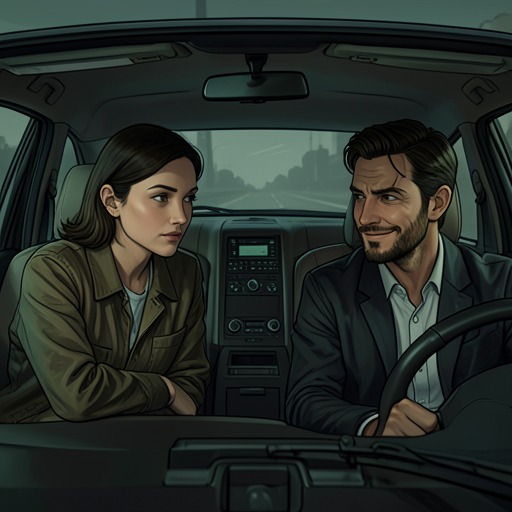
The Senator first calls the marsh route a shortcut, insisting that there is only one direction and that they cannot be lost. Kelly answers carefully that the road is poor. His reply—that it is poor because it is a shortcut—treats her concrete warning as if it confirmed his judgment. The phrase sounds less like navigation than a certainty he expects her to accept.
The exchange occurs as the Toyota travels through a shadowy swamp-thicket, its headlights illuminating a narrow tunnel of road and vegetation. The Senator peers ahead as though he can see through the darkness to the ocean; Kelly sees only the road in the beams and the poor surface beneath them. Their different ways of reading the scene sharpen the line’s tension: his confidence does not mean that he knows the route is safe.
Repetition and Misleading Certainty
The Senator repeats the claim with a qualification: there is only one direction, he says, “—on an island.” The island setting gives the thought the sound of an uncomplicated geographical fact, but the journey itself contradicts its assurance. The Toyota has turned onto Old Ferry Road, a badly rutted sandy track without a sign, no longer maintained by Grayling Township and effectively due to be closed. A new paved Ferry Road has replaced it; the turn for the abandoned road lies three-quarters of a mile beyond the proper turn.
The narrator distinguishes being lost from choosing the wrong road. Strictly speaking, The Senator is still headed toward Brockden's Landing, but he has taken a route no longer used. His turn is described as understandable at dusk, yet the road’s disuse and poor condition make the confidence of the repeated phrase increasingly hollow. The words insist on certainty while the car’s actual direction exposes how little that certainty guarantees.
From Roadside Confidence to Physical Peril
The slogan’s assurance precedes the crash. Traveling at speed, the Toyota hits a sandy rut and skids; The Senator brakes, but the car slides sideways, breaks through the guardrail, and plunges down the embankment into black water. The car is submerged in Indian Creek, whose marshland stretches toward a tidal pool and the Atlantic. The phrase has offered no protection against the road, the vehicle’s loss of control, or the water filling the passenger compartment.
The danger is not presented as a simple consequence of a mysterious wrong turn. The road is an identifiable hazard, and a later account estimates that the car was traveling about forty-five miles per hour from the skid marks and damage. That account also speculates that, had the Toyota lost control on the hairpin curve, it might instead have struck a narrow bridge railing and fallen into the water with a similar result. The repeated assurance cannot settle either the route or the outcome; the narration keeps the distinction between what happened and what might have happened.
Kelly’s Reversal of the Phrase
Trapped in the submerged car, Kelly remembers the line as a promise with a new direction: there is only one direction, and The Senator will come to her from it. She knows, at the same time, that the car is filling by degrees. Her hope that she will be rescued coexists with the practical knowledge that the trapped air cannot last and that black water will eventually rise to her mouth and lungs. The repeated phrase briefly gives her fear a shape she can endure, but it cannot change the physical circumstances.
The expression’s reversal is stark. On the road, The Senator uses it to reassure Kelly while he controls the car’s direction; underwater, Kelly uses its logic to imagine him returning to her. Yet he has already escaped the sinking vehicle in panic, leaving her behind. She tries to understand his actions as blind terror rather than deliberate abandonment, and holds on to faith even as the water rises. What sounded like confident knowledge becomes, for Kelly, a belief in rescue that the reader knows is misplaced.
The Phrase as Structural Irony
The line recurs across a change in narrative knowledge. The journey first unfolds through Kelly’s immediate perceptions: the dark road, the headlights, the poor surface, and The Senator’s repeated assurances. After the crash, the sentence returns inside her submerged ordeal, where its promise collides with the reader’s knowledge that he has reached shore alone. The expression therefore binds two different realities—the shared drive and Kelly’s isolated struggle—without resolving the gap between them.
Its simplicity is part of its force. “Only one direction” can sound like an obvious truth, a navigational judgment, or a promise that no one will be lost. But the journey makes each meaning unstable: The Senator mistakes an obsolete road for the route he intends, Kelly cannot escape the car, and the man she expects to come back has fled. The phrase’s recurrence turns ordinary reassurance into a measure of the distance between authority’s confident performance and the consequences it cannot control.